Everything Is Hard to Explain: A Single Stone May Reveal the Treasure in Oak Island’s Legendary Money Pit. But It Just Keeps Getting Weirder.
It may be less a clue than the reason the mystery never dies.
The Oak Island cipher stone is irresistible. It’s a buried slab with strange symbols and a message that supposedly points to a fantastic treasure worth millions of dollars just a little deeper underground.
In the centuries-old hunt for the Oak Island Money Pit—a rumored treasure shaft on a small island in Nova Scotia—that stone is the clue that should have solved everything.
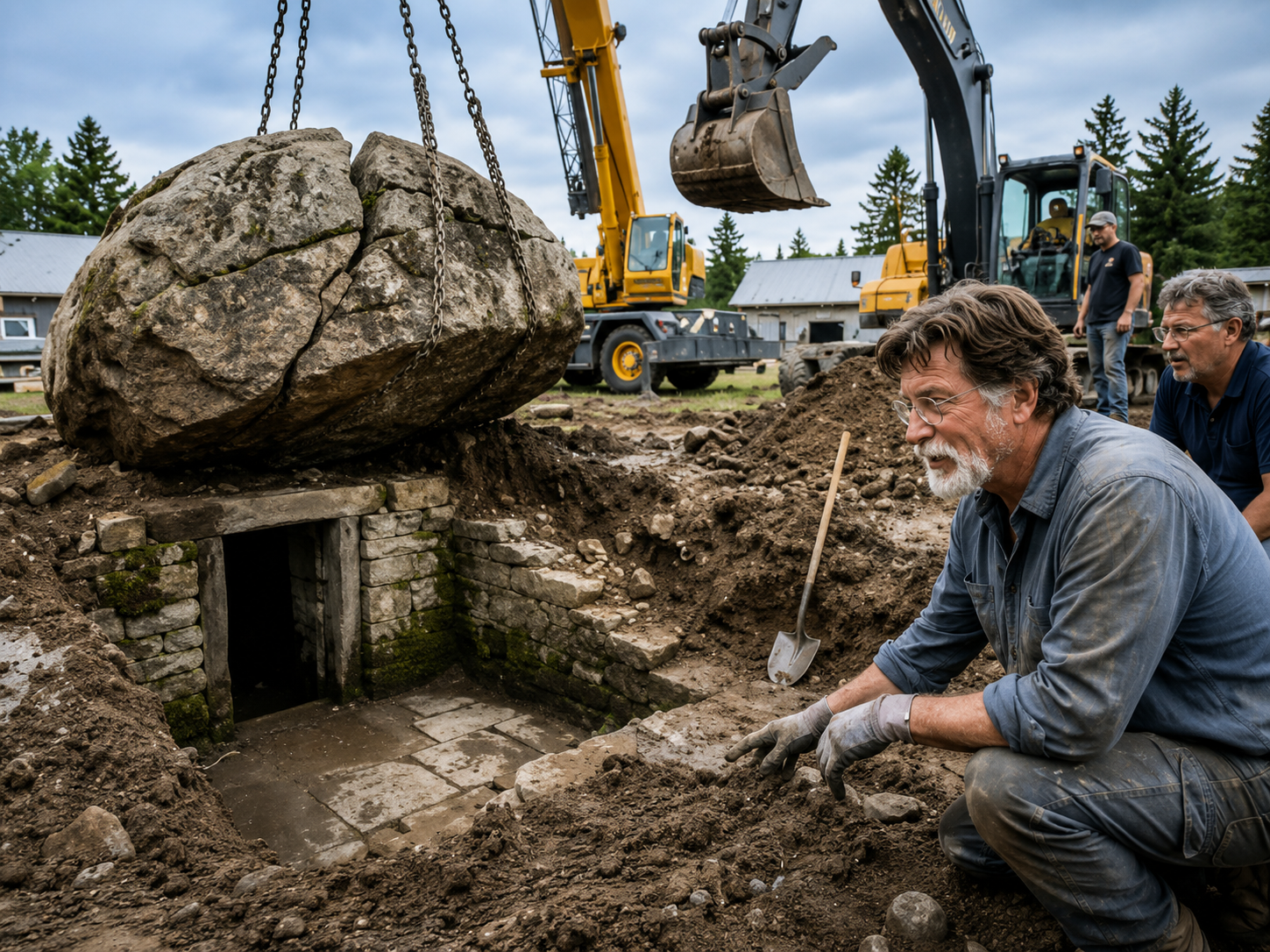
Instead, it may explain why the Oak Island mystery has kept going for more than 200 years.




According to the Oak Island legend, searchers with the Onslow Company found a rectangular stone about 90 feet down in the Money Pit in the early 1800s.
Some observers dismissed the markings as accidental scrapes from excavation tools. Some saw something much more exciting: a mysterious code.
In the most famous version of the story, later attributed to Rev. A.T. Kempton’s 1949 rendering, the inscription was translated to mean, “Forty Feet Below Two Million Pounds Are Buried.
” In the 1970s, others reportedly interpreted the same markings as a Coptic Christian warning.
A clue that can simultaneously mean “dig here for treasure!” or “remember your duty to God” isn’t exactly a smoking gun. So before the cipher stone can help solve the Oak Island mystery, it has to answer a more basic question: Can we even trust this thing at all?
As Dylan Taylor-Lehman reports in Pop Mech’s “The Real Story of Oak Island’s Legendary Money Pit,” this is where things get messy: the stone supposedly became one of Oak Island’s most important clues before anyone had clearly preserved what it looked like or what its symbols actually were:
“The inscribed stone found in the early 1800s wasn’t recorded as found until 1862. The stone wasn’t mentioned at all in the Oak Island Treasure Company’s 1893 Investment Prospectus, and neither itself nor its markings were sketched or photographed. The rendering of the stone that exists today is dated to 1949; that’s where modern translations originate.”
What the cipher stone really does is provide something more useful than proof: a reason to keep asking questions. If the original stone were sitting in a museum, researchers could study the markings, compare the translations, and argue about the same piece of evidence. But without the stone—or even a good early drawing of it—the story can’t be pinned down.
That’s why the cipher stone has lasted. It can be a treasure map, a warning, a mistake, or an embellishment, depending on your flavor. The weaker the record gets, the stronger the legend becomes.
Treasure stories, folklorist Kristina Downs explains, often rely on familiar pieces of “evidence”—a lost object, a curse, a code, a warning—that make an unproven claim feel more solid.
“You could make an argument that there is a common structure to buried treasure [stories],” Downs says. “The treasure being lost somehow, the stories about it are told as true, and the fact that the treasure is never recovered … fall under the category of ‘validating formulas,’ which are added to a legend to help its credibility.”
And that’s the Oak Island mystery in a nutshell: a strange object, different interpretations, and enough unanswered questions to keep people digging.
For the whole story—from alleged flood traps and sinkhole science to the curse, the deaths, and the industrial-secret theory—read Pop Mech’s full investigation.