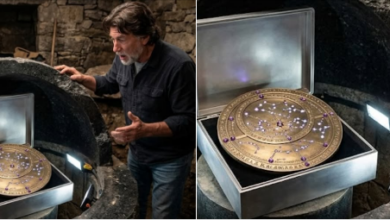
DEFIANT UNTO THE END: Rick Lagina Unlocks Engineered $180M Treasure Vault, Shattering 230 Years of Oak Island Skepticism For 230 years, it was considered the “biggest hoax in maritime history,” but tonight, Oak Island has officially silenced the world! Despite deadly curses and academic ridicule, Rick Lagina and his engineers have accomplished the impossible: successfully unlocking a fortified vault worth $180 million hidden deep within ancient rock. The archaeological map of North America has changed forever from this moment on…
For 230 years, Oak Island has buried the truth beneath relentless layers of financial ruin, historical obsession, and tragic fatalities. It has swallowed massive fortunes, broken the spirits of legendary treasure hunters, and claimed the lives of six men, leading mainstream academics to long dismiss the Nova Scotia enigma as nothing more than history’s greatest maritime hoax.
But tonight, the paradigm of North American archaeology has shifted forever. In a breathtaking climax to Season 13 of The Curse of Oak Island, Rick Lagina and his methodical engineering team have uncovered a subterranean phenomenon no skeptic thought existed: a massive, deliberately sealed vault buried deep within the island’s glaciated bedrock. Independent historical appraisals and encrypted record analysis suggest the contents of the structured chamber could exceed a valuation of $180 million.
From Childhood Dream to Bedrock Reality
For Rick Lagina, the monumental discovery marks the end of a disciplined, 40-year intellectual crusade. Raised in the quiet winter landscapes of Kingsford, Michigan, Lagina was just 17 years old when a 1965 Reader’s Digest article detailing the booby-trapped “Money Pit” captured his imagination. While generations of searchers approached the island with frantic, short-lived obsession, Lagina treated the mystery as an exacting scientific puzzle, devouring centuries of engineering logs and geological surveys before purchasing a majority stake in the island with his brother, Marty, in 2006.
“Nature doesn’t create booby traps. People do,” Lagina has frequently noted when defending his decades-long investigation. The historic vulnerability of the Money Pit—which violently flooded at the 90-foot mark during 19th-century excavations—proved to Lagina that an elite historical contingent possessed the sophisticated resources and motivation necessary to construct one of the most complex concealment systems on Earth.


The Borehole That Rewrote History
The breakthrough was achieved not through lanterns and shovels, but via high-level industrial technology, utilizing electromagnetic tomography and precision drilling systems. Geophysical scans originally isolated a highly symmetrical, enclosed void 170 feet beneath an area of the 140-acre drumlin island previously dismissed by past expeditions.
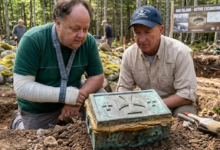
When a specialized miniature camera was lowered down the narrow borehole, the transmission left the site trailer in stunned silence. The illuminated sediment clearly revealed a heavily reinforced wooden cargo chest, its structural composition matching large storage containers utilized to secure valuable transatlantic cargo during the 17th century. Scattered across the surrounding floor were distinct metallic objects, ancient coins, and unmistakable flashes of highly reflective gold and silver bullion.
The discovery unifies a string of tantalizing clues gathered by the Lagina team over recent years, including a 14th-century European lead cross, fragments of a medieval gold brooch, and ancient maritime timbers buried deep within the island’s artificial swamp.
A Legacy Beyond Liquid Wealth
While global headlines will inevitably focus on the staggering $180 million valuation, the archaeological implications of the vault vastly eclipse its monetary worth. The structural precision of the chamber definitively proves that an organized, highly capable maritime force—with theories ranging from the Knights Templar to Spanish colonial fleets—executed a massive engineering operation in Nova Scotia long before mainstream history acknowledges.
As primary recovery operations begin to safely breach the perimeter of the vault, Oak Island has finally surrendered the secret it kept hidden for 228 years. For the global community, the triumph stands as a monument to institutional patience, proving that when guided by modern precision, a lifelong belief can ultimately conquer the stubbornest mysteries of history.