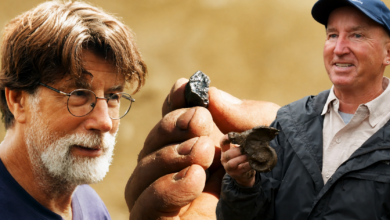
THE VIKING DRAKAR: Lagina Brothers Unearth Ancient Norse Wooden Dragon Motif on Oak Island Just when the global audience believed the Season 13 finale of The Curse of Oak Island could not possibly hold any more surprises, the Fellowship of the Dig has delivered a stunning archaeological bombshell. Rick and Marty Lagina have made a breathtaking new discovery in a newly drained swamp sector…
Just when the global audience believed the Season 13 finale of The Curse of Oak Island could not possibly hold any more surprises, the Fellowship of the Dig has delivered a stunning archaeological bombshell. While the team continues to analyze the paradigm-shifting 12,000-year-old Astrolabe and protect the vacant excavator seat of the recovering Billy Gerhardt, Rick and Marty Lagina have made a breathtaking new discovery in a newly drained swamp sector. The team has officially excavated a beautifully preserved, ancient wooden dragon carving—unmistakably matching the traditional decorative prow motifs of a Viking Longship.
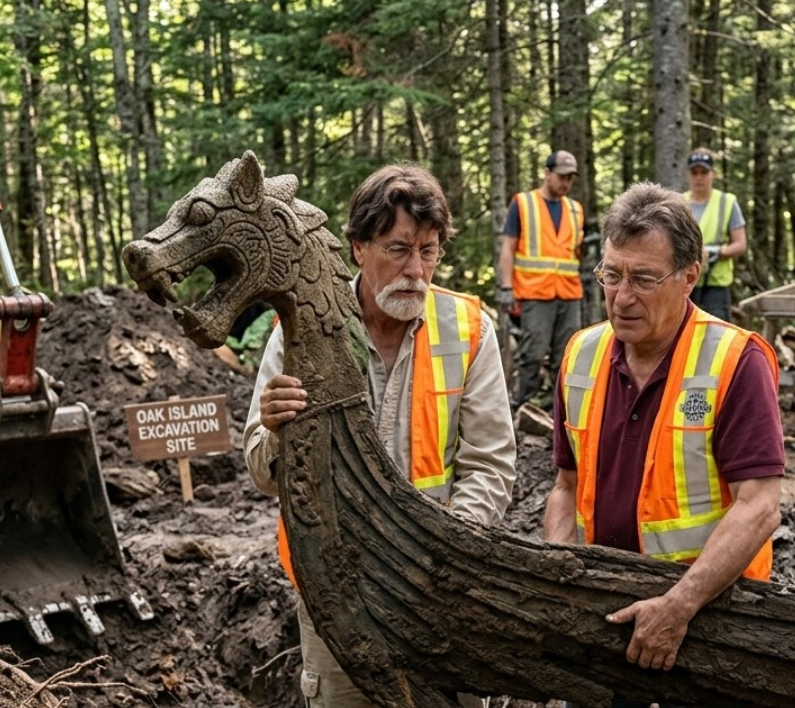
The artifact was recovered from a deep layer of anaerobic peat moss, a highly unique environment that prevents oxygen from rotting organic matter. This natural preservation allowed the intricate, tightly coiled Norse dragon design to survive intact, buried beneath centuries of Nova Scotian silt.
The Awakening of the Dragon
The discovery occurred during a targeted excavation near the triangle-shaped swamp, a zone long suspected by historical researchers Doug Crowell and Paul Troutman to hold maritime secrets. Operating under strict safety protocols due to previous explosive hazards on the western drumlin, Rick Lagina personally spotted the dark, curved timber emerging from the mud.
As the mud was painstakingly washed away by artifact conservator Emma Cullen, the unmistakable features of a Norse Drakar (dragon) came to light. The carving features bared teeth, stylized serpentine scales, and deep, geometric grooves characteristic of the 10th-century Borre or Jelling beast styles.


“I was absolutely speechless,” an emotional Rick Lagina stated while examining the timber in the research center. “We have found silver ingots, ancient coins, and the spectacular purple gemstone, but holding a piece of hand-carved history that directly links Oak Island to the Norse sagas is an indescribable feeling. It’s a literal awakening of the past.”
Rewriting the Pre-Columbian Timeline
While rumors of Norse exploration in North America have been proven by sites like L’Anse aux Meadows, finding a definitive Viking ship motif this far south in Nova Scotia is a revolutionary historical event.
Marty Lagina, ever the pragmatic engineer, immediately initiated a scientific audit of the wooden artifact. Initial dendrochronology (tree-ring dating) and rapid carbon testing have placed the timber’s origin between 950 AD and 1050 AD—the absolute height of the Viking Age.
-
The Metallurgy Connection: XRF scanning of trace iron rivets still embedded in the base of the wooden dragon revealed a composition identical to bog iron smelted in ancient Scandinavia.
-
The Structural Intent: Rather than a discarded relic, the positioning of the dragon prow suggests it may have been intentionally buried or hidden within a man-made slipway, potentially as a sacred marker or a defensive territorial boundary.
The Tactical Overlap: Templars and Vikings?
In the War Room, the atmosphere has transformed into an intellectual crucible. The discovery of the 1,000-year-old Viking dragon has forced the team to re-evaluate how it connects to the Garden Shaft mysteries and the Templar Relic theories.

One compelling hypothesis raised by Alex Lagina suggests that early European voyagers may have utilized old Norse navigational routes—or even discovered existing Viking markers—to locate the strategic isolation of Oak Island centuries before Columbus sailed.
A Masterpiece for a Waiting Hero
The victory at the swamp was bittersweet for the crew, who missed the steady presence of Billy Gerhardt. However, following Billy’s recent emotional visit to Lot 5 where he vowed to conquer his orthopedic rehabilitation, the team dedicated the breakthrough to their sidelined brother.
As Season 13 charges toward its historic conclusion, the “Wooden Dragon” stands as a majestic testament to the layers of history hidden within the island’s shores. Oak Island is no longer just a money pit; it is a crossroads of ancient world civilizations, where Norse warriors, medieval knights, and lost epochs collide in the dirt.